Thursday, February 13, 2014

A Marine remembers Pearl Harbor

Here is a guest post from my friend, John Larson's, blog, The Magdalena Dispatch.

Pearl Harbor is always a strange and horrifying story. I never have been able to understand the things human beings do to one another and the things that happened in the war that ensued are as terrible as any that have ever happened throughout history. From Bataan to Auschwitz, the world was black indeed.

Remembering


For years Rudy Pina proudly flew the flag of the Marine Corps every day above his home in rural New Mexico. Pearl Harbor Day 2013 was last weekend, and I thought of my late friend.


Rudy Pina at home in 2007

He died at age 94 in 2012, but not before he shared with me many of his memories from being stationed at Pearl Harbor on December 7, 1941.
Enlisting in 1938, the Arizona native was a gunnery sergeant in the U.S. Marine Corps whose unit was bivouacked at the time in tents near the harbor. But his recollections of the attack begin the week before, on Sunday, Nov. 30, at church.
“I had went up to church the week before, and sat in the back with another Marine,” he said. “In came a brand new ensign. He had just arrived on the base with his young wife.” After the services the officer approached Pina and his buddy, he recalled. “We got to talking and he said ‘You Marines doing anything? How would you like to take a tour of the island, show us what's what’?” Rudy said. “He said ‘Come with us.’ He and his wife drove us all over the island, up to Scofield Barracks and down to the rest of the island.”
He said their sightseeing tour ended at what Pina called “officers country,” a club not open to non-commissioned officers. “We drove up to a sentry, who was surprised to see us enlisted guys, but the ensign said it was okay,” he said. “So we came in, and sat down at a table. We only had 35 cents to drink with.”

Rudy said two nurses on an outrigger moored at the club invited him and his buddy to join them for dinner. “The ensign comes over and said, ‘we’re going to go,” and the nurses said, “we’ll take them home,” Pina said. “We stayed and ate and were swimming, and then dancing in our swimsuits until the place closed at nine o'clock.”

“We told them we lived down at Pearl Harbor, and they drove us down,” he said. The same sentry was surprised to see them this time with the nurses, who told them “never mind, they’re our guests." Before dropping them off at the encampment, Rudy and his buddy tore open their shirts and asked the nurses to smear lipstick on them as a joke "for the other guys to see." The other guys were duly impressed. "A friend asked how did we meet those nurses," Rudy laughed. “At church we said. He said he would be going to church us the next Sunday!"

The next Sunday was December 7.

"That morning everyone had a hang-over.” Rudy had been out jitterbugging the night before, and a photograph of him dancing with a young woman appeared in the Honolulu Times in the December 7, 1941 Sunday morning paper. He kept a copy of that newspaper.

"But I was up and ready to go to church before 8 a.m., but my buddy was slow getting dressed in the tent," Rudy said. Then..."they came from out of the north."

“The first Zero came in and just cleared the tent. I could see his face it was so low,” he said. “He had a big grin on his face." That plane hit the battleship California, which was moored at Ford Island. “Two more came in, and I grabbed a .50 caliber machine gun, and shot the third plane down,” Rudy said. “The guys went to where it came down and got to chopping on the pilot.”

He said while they were shooting at the planes, they were also waiting for orders. “They were dropping bombs and everything else. Sailors were running out in their skivvies. I told them, ‘go in the tent and get what you need’,” he said. “We dragged a couple of guys out of the water and we took some to the mess hall.”

Rudy said he finally got orders when an officer came up to him. “He said, ‘Pina get your ass going, we’ve got to get the ammunition out of here!' We pulled out and a Colonel Hall called ahead to arrange the delivery of ammunition to where it was needed around the harbor.”

“They loaded us up right away and I zig-zaged all the way,” Rudy said. “That was the way to drive the truck around. But one guy got a little piece of shrapnel.” Although the attack lasted about two hours, he said the rest of the day was spent with emergency and rescue efforts. “I had a motorcycle and was sent all over delivering messages and medicine,” Rudy said. “The bike let me get through places a truck or jeep couldn’t. They sent me all over.”

Rudy was also part of an effort to get medical supplies to Ford Island. “They had this tug to get to Ford Island,” he said. “To get there we had to go through a fire so it had four pumps going to get through. We got the medicine over there. They really wrecked that island.”

That was the beginning of the long war for Rudy, who was sent to New Zealand for combat training, and then to Guadalcanal, Tarawa, Saipan, Tinian, Iwo Jima, and Okinawa.

"Tarawa was the worst," he said. By the time World War II ended he had been wounded one time. "I did catch a little shrapnel. I was lucky."

His first tour of duty was in Shanghai, China. In early 1941 his unit was split, "one half was transferred to Manila in the Philippines, and my half was sent to Hawaii."

Wednesday, December 18, 2013

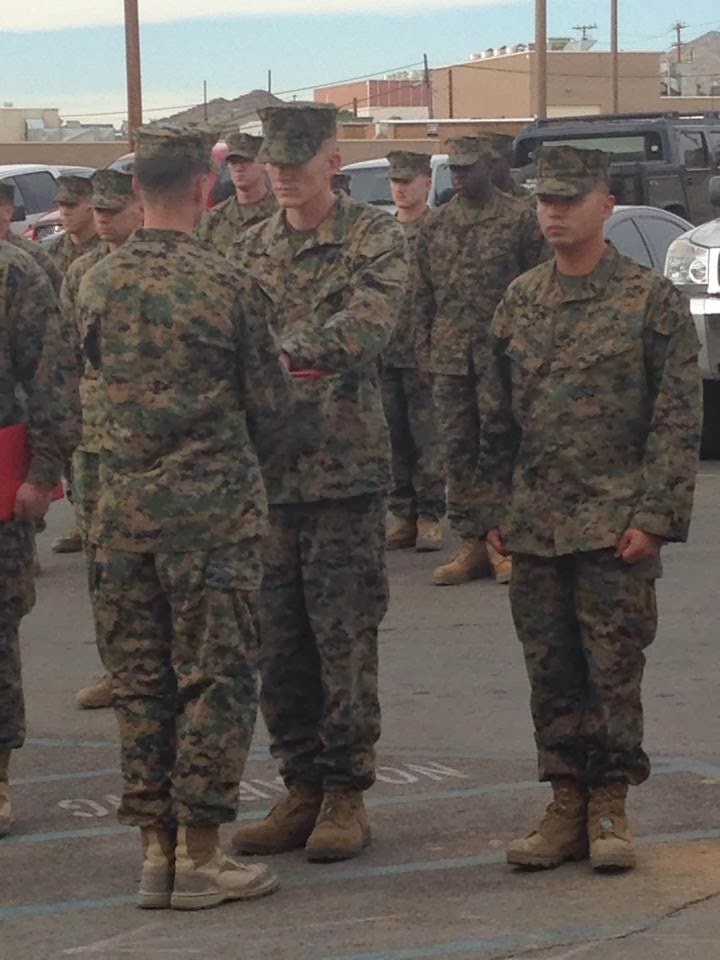
Marine rank: Corporal

Another rank has come upon my son. Another proud day. I am surprised daily as his nature stays the same. His kindness and humor are as intact as they ever were.
Marines have a reputation (in San Diego at least) of being stuck up, proud of themselves and inconsiderate of others. Mine says he can be that way too, but at least I never see it.
The rank is one implying the command of a section or squad of others. As a Marine corporal an individual is a rifle fire team leader, machine gun team leader, light mortar squad leader and assault weapon squad leader.


"A Corporal in the Marine Corps is a junior noncommissioned officer, and is equivalent in rank to the Army's junior NCO ranks of Corporal and Specialist. Corporals usually command small contingents of Marines in combat and operations, including four-man fireteams (which may also be lead by a Lance Corporal) or eight-man squads comprising of two fireteams.
"The Marine Corps specializes in small-unit operations, and as a result Corporals hold a significant amount of authority and resposibility in contrast to the lighter duties of Lance Corporals and Privates. Because of the responsibilities delegated to squad and fireteam leaders, promotion to Corporal is seen as a very significant accomplishment for an enlisted Marine.
"Promotion to Corporal is awarded on a rolling basis to experienced soldiers who achieve a qualifying composite or cutting score in a variety of assessments." Military Ranks

Arrotta’s tactical call sign was “India 14” which identified him as the company’s Forward Air Controller. (Courtesy of Joanne Schneider) 

Monday, October 21, 2013

Homecoming

After deployment, our Marines come home. Our hearts sing and we fly into their arms. We can only hope the changes wrought inside them are ones that will grow and meld with the family, slide quietly to the side; allow us to sing and meld with our children, husbands, fathers, sisters and brothers. We can hope to be whole again.

Homecoming: How hard is it?
And what have they missed, the first teeth, the first school, the children growing and expanding as our Marines expand their knowledge of the world. Their service, their hearts, their own childhoods all creating turmoil within.

Cherry Point
What else will they still face? Will they be greeted by the world at large? Shunned? Accepted? Thanked?

Above and Beyond Cakes

ProgressNow
And they will continue coming home ... human. Some will come whole, some not. Some to fight on, some to stop. We will take them in our arms and our hands will feel their faces, hair, shoulders. There will be tears and happiness and sometimes loneliness. But for now ... they are home and that is what our smiles wait for. We will welcome.

Marines Welcomed Home

Sometimes we just wait.

Marine Homecoming


Monday, May 27, 2013

What use for children?

 Children: Friend or foe?


HIT, Iraq (Sept. 15, 2005) - Top photo, Lance Cpl. Randy B. Lake, a Battle Ground, Wash. native and radio operator with India Company, 3rd Battalion, 1st Marine Regiment talks to some children during a patrol. (Official Marine Corps photo by Cpl. Adam C. Schnell). Bottom photo, It's about the warrior.

Some Afghan kids aren't bystanders
By Dan Lamothe and 

CAMP LEATHERNECK, Afghanistan — When Marines in Helmand province sized up shadowy figures that appeared to be emplacing an improvised explosive device, it looked like a straightforward mission. They got clearance for an airstrike, a Marine official said, and took out the targets.
It wasn't that simple, however. Three individuals hit were 12, 10 and 8 years old, leading the International Security Assistance Force in Kabul to say it may have "accidentally killed three innocent Afghan civilians."
But a Marine official here raised questions about whether the children were "innocent." Before calling for the M142 High Mobility Artillery Rocket System mission in mid-October, Marines observed the children digging a hole in a dirt road in Nawa district, the official said, and the Taliban may have recruited the children to carry out the mission.
The incident underscores a continuing problem across Afghanistan. The use of children by the Taliban — through recruitment and as human shields — complicates coalition forces' efforts to eliminate enemy fighters from the battlefield without angering civilians.
The New York Times reported that the dead children's family members said they had been sent to gather dung, which farmers use for fuel. Taliban fighters were laying the bombs near the children, who were mistakenly killed, they said.
Regardless, it's one of many times the children have been involved in the war. In a case this year, Afghan National Police in Kandahar province's Zharay district found two boys, ages 9 and 11, with a male 18-year-old carrying 1-liter soda bottles full of enough potassium chlorate to kill coalition forces on a foot patrol.
"It kind of opens our aperture," said Army Lt. Col. Marion "Ced" Carrington, whose unit, 1st Battalion, 508th Parachute Infantry Regiment, was assisting the Afghan police. "In addition to looking for military-age males, it's looking for children with potential hostile intent."
There were 316 documented cases of underage recruitment in the war last year, most of them attributed to the Taliban and other armed groups like the Haqqani network, according to a U.N. report released in April. Eleven children, including an 8-year-old girl, were killed in Afghanistan last year carrying out suicide attacks, the report said.
Marines in Helmand say the Taliban regularly recruit children to serve as spotters, letting armed insurgents know when U.S. or Afghan forces reach designated points on a patrol so they can prepare an ambush.
An ISAF spokesman, Lt. Col. Jimmie Cummings, said insurgents continue to use children as suicide bombers and IED emplacers, even though Taliban leader Mullah Omar has ordered them to stop harming civilians.
Lamothe reported from Afghanistan. Gould reported from Washington.

Wednesday, April 10, 2013

Camp Leatherneck

Camp Leatherneck is a 1,600 acre United States Marine Corps base located in Helmand Province, Afghanistan. The site is located mostly in Washir District and is conjoined with Camp Bastion, the main British military base in Afghanistan. It is the United States Marines base that is the home base of most Marine operations in Afghanistan.  


Camp Leatherneck was officially dedicated on May 29, 2009, and originally housed around 4,000 marines and civilians in large tents with hundreds of cots in each one. Camp Leatherneck is now home to 10,000 to  20,000 Marines and civilians, and many upgrades to the camp have been made. There are now one story pre-fabricated buildings that can house about 2,000 people in each building, which is certainly an upgrade to the 20 man tents this base started out with.

One of the major upgrades to Camp Leatherneck was a new 3,828 yard runway. The runway is actually built at the adjacent Camp Bastion a British base, but will allow for larger planes such as the 747 passenger planes and the C-5 cargo planes. This extended runway with a capacity for larger planes will help keep the troops better supplied since they will no longer have to rely strictly on smaller supply planes.

Another upgrade is more gym space. In the beginning, Camp Leatherneck had only one gym, and though it was open 24 hours a day it was always overcrowded. Now there are four fitness facilities each devoted to a specific use. There is now a gym for weight-lifting, CrossFit training, cardiovascular health, and one general use gym with a variety of exercise equipment.

One of the most popular upgrades to Camp Leatherneck is their dining system. In the beginning there was only one chow hall, and now there are two each capable of serving 4,000 Marines per meal. Camp Leatherneck has also received a new PX. Before the PX had only 3,000 square feet of sales floor which was not nearly enough for the large number of Marines on base. Now they have a much larger building with roughly  10,000 square feet of display area, plus more storage to help keep the shelves fully stocked. Camp Leatherneck


CAMP LEATHERNECK, Afghanistan (Nov. 26, 2009) Secretary of the Navy (SECNAV) the Honorable Ray Mabus serves turkey to Marines and Sailors Thanksgiving Day at Camp Leatherneck. U.S. Navy photo by Mass Communication Specialist 2nd Class Kevin S. O'Brien

If my Marine son were there in 2009 this could be what he would have been doing -- 
pulling these trucks out of the mud:

“The Marines and I were stuck in Leatherneck for 3 days due to heavy rains and severe weather until it cleared enough to finally receive the trucks.  The next morning after the weather passed, the team and I began the start of the mission out of Leatherneck by pre-starting and performing preventive combat maintenance on the vehicles.  Within the first hour of the journey, one of the trucks in the convoy became stuck in the mud.  After multiple times of vehicles becoming stuck in the mud, the truck that would always save the day by pulling us out earned the rightful name of Hercules by the convoy team.” Oops
Then of course a dip into Marine humor is needed:
Deployed U.S. service members in Afghanistan put up with a lot. Not only is there the threat of improvised explosive devices, small-arms ambushes and indirect fire attacks, there’s the lousy food, hostile weather and lack of plumbing. Crapper rules

Photographer Colin Kelly spotted the poster depicted above at Camp Bastion, the British base in Helmand province that is home to thousands of deployed Marines in aviation units. Clearly, a frustrated Marine leader somewhere decided the best way to crack down on messy port-a-johns was to post some rules of the road. And if you’re going to lay the law of the lavatory down, a little sarcasm and blunt talk never hurt.


Ooooo-Rah!

Wednesday, January 30, 2013

Just running around


Marine Sgt. on Cross-Country Run Stops in New Mexico
 “The Run for Veterans” 3,600 Mile Journey Aimed at
Calling Attention to/Raising Money for Post-Combat Veterans’ Issues


New Mexico Department of Veterans' Services Secretary Timothy Hale presenting a state Flag to Brendan O'Toole  in front of the Eternal Flame Monument at the Bataan Memorial Building in Santa Fe.


A Marine Sergeant on a cross-country run to help call attention to veterans’ issues has stopped in New Mexico for a few days—catching his breath and visiting with New Mexico Department of Veterans’ Services Secretary Timothy Hale before heading back on the road.


24-year old Brendan O’Toole—a native of Alexandria, Virginia—began The Run for Veterans last Veterans’ Day  from Oceanside, California (near Camp Pendleton just north of San Diego) on a 3,600-mile journey to Portland, Maine. His goal is to finish sometime near the end of the year and to raise $2 million for to help Iraq and Afghanistan War veterans.

O’Toole served two tours with the Marines; first in Haiti and Somalia, and then Afghanistan—finishing his second tour last spring. It was here during “down time” while watching the movie Forrest Gump--the Oscar-winning movie starring Tom Hanks about a Marine who ran across the country after serving in Vietnam--that the seed was planted  to one day do the same.
When O’Toole returned home to Virginia, he began noticing that a lot of friends who also served in Afghanistan and Iraq were having a hard time re-adjusting to “normal” civilian life.

“For whatever reason, a lot of my friends were not handling their new lives very well,” explained O’Toole when meeting with NMDVS Secretary Hale to explain his mission. ”They were abusing alcohol or drugs, tuning people out—just having a lot of personal issues going on.”

O’Toole had also decided to take up running to “de-compress” after his latest tour in Afghanistan. When one of his ex-combat friends who had been having a particularly difficult time readjusting to life back home committed suicide, O’Toole recalled a promise he made to that friend:  Running across the country “like what Forrest Gump did.”

O’ Toole found his new post-military mission: A cross-country run--not only to see the sights—but with a purpose: Calling attention to the need to help our newest generation of veterans cope with life after service

He created a website to solicit pledges—with all money after gas, food and lodging expenses are deducted going to three agencies which provide physical, mental and social support for soldiers and veterans: Give an Hour; Team Red, White & Blue; and the USO.

“The respect for military service and veterans is amazing here in New Mexico,” said O’Toole. "Only three weeks into this, I think I have noticed that the farther you get our from the cities, the more in-tune people are with military members. It almost seems like outside of the cities is the heart of America." 

For more information about The Run for Veterans and to pledge a donation, go to http://www.therunforveterans.org


This story was provided by the New Mexico Department of Veterans' Services.

Monday, November 26, 2012

Marine Corps: Born in a bar

U.S. Marines Birthplace


The U.S. Marine Corps celebrates its birthday on November 10, 1775, the day the Second Continental Congress passed the Continental Marine Act of 1775, ordering, “That two battalions of Marines be raised…” The Continental Marines disbanded in 1783, and was formally reestablished in 1798. The first Marines enlisted at Tun Tavern in Philadelphia, which is considered the birthplace of the Marine Corps. mentalfloss 

Tun Tavern is where the Marine Corps held its first recruitment drive during the american Revolution. 


 In the year 1685, Samuel Carpenter built a huge "brew house" in Philadelphia.  He located this tavern on the waterfront at the corner of Water Street and Tun Alley.  The old English word tun means a cask, barrel, or keg of beer.  So, with his new beer tavern on Tun Alley, Carpenter elected to christen the new waterfront brewery with a logical name, Tun Tavern. In 1756 Col. Benjamin Franklin organized the Pennsylvania Militia.  He used Tun Tavern as a gathering place to recruit a regiment of soldiers to go into battle against the Indian uprisings that were plaguing the American colonies.  George Washington, Thomas Jefferson, and the Continental Congress later met in Tun Tavern as the American colonies prepared for independence from the English Crown.  On November 10, 1775, the Continental Congress commissioned Samuel Nicholas to raise two Battalions of Marines.  That very day, Nicholas set up shop in Tun Tavern.  He appointed Robert Mullan, then the proprietor of the tavern, to the job of chief Marine Recruiter -- serving, of course, from his place of business at Tun Tavern.  Prospective recruits flocked to the tavern, lured by (1) cold beer and (2) the opportunity to serve in the new Corps of Marines.  So, yes, the U.S. Marine Corps was indeed born in Tun Tavern.  Needless to say, both the Marine Corps and the tavern thrived during this new relationship. USMC Heritage
Tun Tavern burned down in 1781, near the end of the American Revolution.

All Things Masonic


 The National Museum of the Marine Corps in Quantico, Virginia contains a Tun Tavern-themed restaurant with a lunch menu, alcoholic beverages, and bread pudding. The decor of the tun tavern restaurant features a large painting depicting famous Marines from the founding of the corps to the present day.

Roaming the Planet:: The museum’s Tun Tavern captures the warmth of the original and features food inspired by the Colonial era.

There is even a Tun Tavern Marines Motorcycle Riding Club.

Tun Tavern Marines


But then again:
From the book, The Marine Corps Story, by J.Robert Moskin, 1992, Little, Brown and Company"...The two battalions were never raised; but onNovember 28, the Congress commissioned thirty-twoyear old Capt. Samuel Nicholas, a PhiladelphiaQuaker, and innkeeper and a blacksmith's son, asthe first Marine officer. A hundred volunteers,recruited in Rhode Island, arrived atPhiladelphia by December 5...probably signed upin Robert Mullan's Tun Tavern."
And, from the book, The United States Marines AHistory, by Edwin Howard Simmons. 1998, NavalInstitute Press"...According to legend, the recruiting redezvouswas Tun Tavern, but it is more likely that it wasthe Conestoga Wagon, a tavern owned by theNicholas family on Market Street between Fourthand Fifth Streets."
And, from the book, Marine Corps Book Of Lists,Albert A. Nofi, 1999, Combined Publishing"...Eight Hoary Old Marine Corps Legends That AreNot True. 1. The first Marine recruiting stationwas established in Tun Tavern, in Philadelphia,the proprietor of which was so adept at securingrecruits, by liberally plying them with drink,that he was made a captain in the Corps. Alas for"romance," the story is untrue. It probably gotits start from the fact that Samuel Nicholas,effectively the first Marine Commandant, actuallydid own a tavern in Philadelphia, the ConestogaWagon, which apparently served as hisheadquarters for a time. However the owner of theTun Tavern did become a Marine officer, about ayear after the creation of the Corps, whichprobably gave rise to the legend. Legends and Myths Of The Corps